
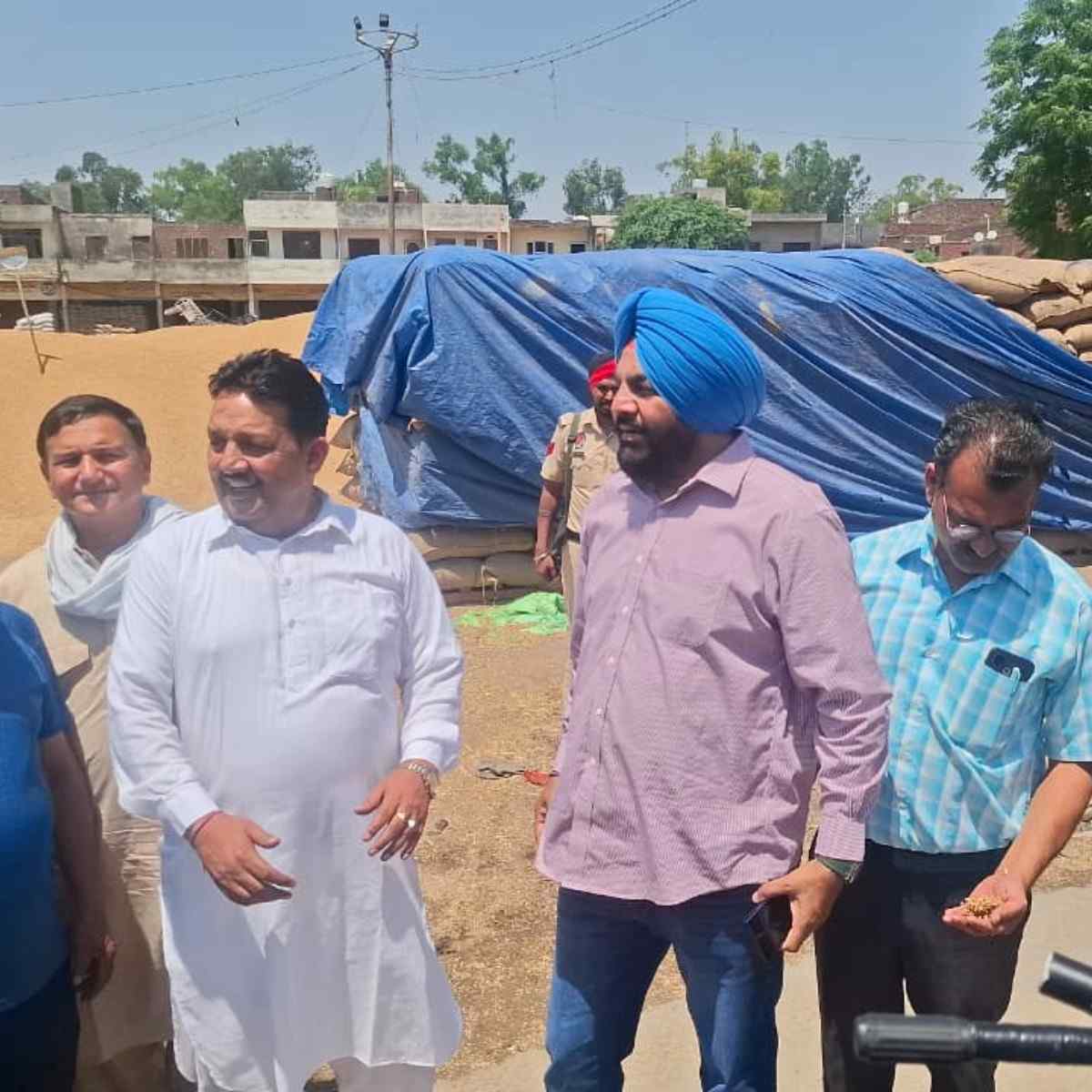
Amritsar (Dawarka Nath Rana): The Punjab wheat procurement crisis has deepened further as Congress MP Gurjeet Singh Aujla visited Bhagtanwala Dana Mandi in Amritsar on Wednesday to review ground realities amid worsening weather and sluggish wheat lifting operations.
Amid light rainfall and overcast skies, Aujla expressed serious concern over massive quantities of wheat lying in the open. The exposed grain, he warned, is highly vulnerable to damage, intensifying the ongoing Punjab wheat procurement crisis. He questioned the state government’s preparedness and efficiency in managing procurement, lifting, and storage arrangements.
After interacting with farmers, commission agents, and laborers, Aujla said the mandi system in Punjab has “completely collapsed.” He pointed out that lakhs of wheat bags are lying uncovered across mandis in border areas, including Amritsar, increasing the risk of spoilage due to rain.
Providing figures, Aujla revealed that nearly 6.05 lakh wheat bags are currently lying in mandis, but only 10% lifting has been completed, which he described as “deeply alarming.” The slow pace of lifting has significantly worsened the Punjab wheat procurement crisis, leaving farmers anxious about potential losses.
He further highlighted that mandis in Ajnala, Lopoke, Bhindi Saidan, and Majitha are facing even worse conditions. These locations lack essential infrastructure such as covered sheds, tarpaulins, and proper storage facilities, making the wheat stock highly susceptible to weather damage.
Warning of serious economic consequences, Aujla said that if urgent steps are not taken, the Punjab wheat procurement crisis could lead to heavy financial losses for farmers, whose livelihoods depend on timely procurement and safe storage of their crops.
The Congress MP also leveled serious allegations regarding irregularities in the tendering process. He claimed that nearly 70–80% of transport contracts were awarded to parties that do not even own trucks. According to him, contracts were issued based on “paper vehicles,” which has severely slowed down the wheat lifting process and worsened the crisis.
Raising questions over government priorities, Aujla remarked, “If the government can arrange buses from other states, why can’t it arrange trucks for wheat lifting?” He stressed that the lack of transparency and accountability in the tender process is directly harming farmers and commission agents.
He also criticized the state government’s claim of completing lifting and payments within 72 hours, calling it a “complete failure.” Ground reports, he said, clearly indicate prolonged delays, adding to the burden of farmers already struggling due to adverse weather.
In addition to delayed lifting, Aujla pointed out other issues contributing to the Punjab wheat procurement crisis, including theft and damage caused by stray animals in mandis. These problems, he said, are further compounding farmers’ distress.
Taking a sharp dig at the Aam Aadmi Party government in Punjab, Aujla accused the administration of focusing more on publicity than on actual governance. He alleged that the government has failed to deliver on ground-level execution, particularly in managing agricultural infrastructure.
Beyond procurement concerns, Aujla also raised serious questions about the law and order situation in the state. He claimed that in border areas, people are hesitant to step out after 7 PM, with shops closing early due to fear and insecurity.
“Today, people are more worried about their safety than even their daily bread,” Aujla said, underlining broader governance failures.
Concluding his visit, Aujla issued a strong warning, stating that unless immediate improvements are made in wheat lifting, storage, and mandi management, the Punjab wheat procurement crisis could escalate further, causing significant losses not only to farmers and traders but also impacting the wider economy.
Top 5 Key Points of wheat procurement crisis:
- Punjab wheat procurement crisis worsens as wheat lies exposed
- Only 10% lifting completed out of 6.05 lakh wheat bags
- Poor mandi infrastructure: lack of sheds, tarpaulins, storage
- Allegations of corruption in transport tender allocation
- Farmers face heavy losses due to rain, delays, mismanagement