
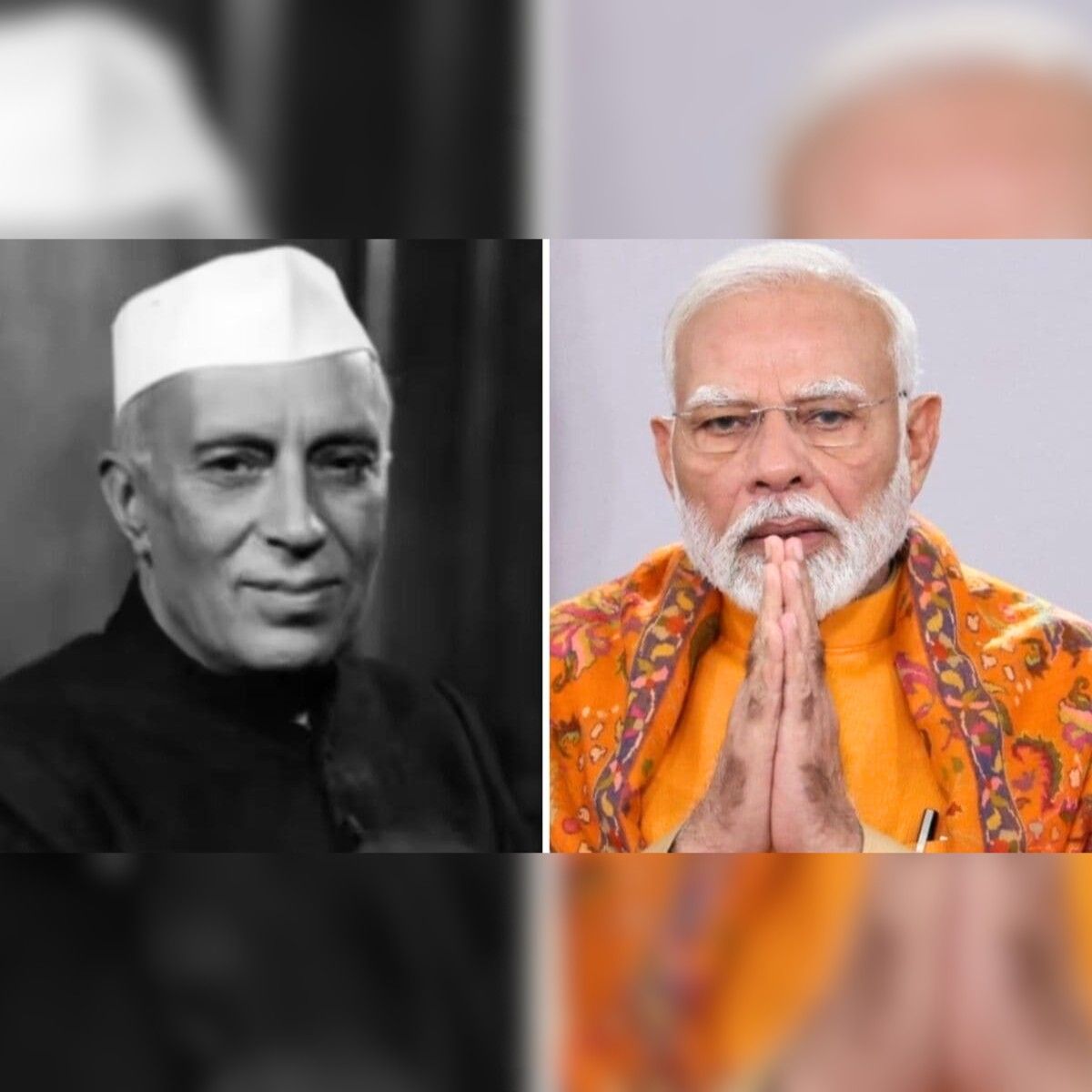
New Delhi: Prime Minister Narendra Modi is set to surpass the record of Jawaharlal Nehru as the longest continuously serving democratically elected Prime Minister of India. This milestone has sparked a deeper reflection on India’s evolving political journey. Moreover, the PM Modi Nears Nehru Record comparison between the two leaders highlights how differently they reached the highest office in Indian democracy. While both shaped the nation for long periods, their political paths emerged from entirely different eras.
Nehru’s Rise in Post-Independence India
Jawaharlal Nehru assumed office in 1947 during a historic turning point for India. He emerged as a natural political successor of the freedom movement.
In addition, the Indian National Congress enjoyed unmatched legitimacy at the time. The party carried the moral authority of the independence struggle and strong public trust.
Furthermore, Mahatma Gandhi’s support strengthened Nehru’s leadership position. The political environment remained largely unified, with limited organized opposition.
As a result, Congress dominated national politics, and Nehru led a newly independent nation with broad acceptance. However, his primary challenge focused on building democratic institutions rather than competing in a fragmented political system.
A Dominant but Less Competitive Political Landscape
During Nehru’s era, India experienced a largely centralized political structure. The Congress party held strong influence across the country.
Moreover, opposition parties remained weak and divided. Public sentiment, shaped by the freedom struggle, also reinforced Congress dominance.
Therefore, leadership transitions within the system occurred with relatively limited electoral competition compared to later decades.
At the same time, Nehru faced the massive responsibility of nation-building. He worked to establish democratic institutions, governance systems, and constitutional frameworks.
PM Modi’s Rise in a Competitive Democracy
In contrast, Narendra Modi’s political journey developed in a highly competitive democratic environment. His rise to national leadership came after decades of organizational work and electoral participation.
Moreover, he built his political career through grassroots engagement, state governance experience, and continuous election campaigns. Unlike the early post-independence period, Modi emerged in an era defined by coalition politics, regional power centers, and ideological competition.
As a result, national leadership required sustained electoral success and strong political mobilization rather than inherited dominance.
Fragmented Politics and Electoral Challenges
The late 20th and early 21st centuries in India witnessed coalition instability and shifting political alliances.
In addition, corruption controversies, regional party expansion, and competing narratives shaped the political environment.
Therefore, leaders had to win repeated electoral mandates to maintain national authority.
Unlike the earlier Congress-dominated system, leadership in this period depended on continuous public validation through elections.
Two Different Eras of Indian Democracy
The comparison between Nehru and Modi reflects two distinct phases of India’s democratic evolution.
On one hand, Nehru led during a time of national unity and post-independence optimism. On the other hand, Modi rose through decades of electoral competition and fragmented political structures.
Moreover, Nehru benefited from the legacy of the independence movement and strong institutional trust in Congress. In contrast, Modi built political strength through sustained campaigning and organizational expansion.
Therefore, their leadership journeys reflect fundamentally different political realities.
Significance of the Milestone
As PM Modi Nears Nehru Record, the moment highlights how India’s democracy has transformed over time. In addition, it shows the shift from one-party dominance to a highly competitive electoral system.
Furthermore, it underlines how leadership in modern India depends on repeated public endorsement through elections.
Ultimately, this milestone is not only about tenure length but also about the changing nature of political legitimacy in India.
Conclusion
The upcoming record underscores the evolution of India’s democratic framework. Nehru and Modi represent two distinct political eras shaped by very different challenges. Moreover, the comparison highlights India’s journey from post-independence consolidation to a vibrant, competitive democracy.
As a result, PM Modi Nears Nehru Record this milestone becomes a reflection of both continuity and change in India’s political history.
Key Points of the PM Modi Nears Nehru Record:
- PM Modi is set to surpass Jawaharlal Nehru’s record tenure on June 10, 2026.
- Nehru rose in a Congress-dominated, post-independence political era.
- Modi emerged through competitive elections and coalition-era politics.
- India shifted from one-party dominance to a highly fragmented democracy.
- The milestone reflects the evolution of India’s democratic system.